
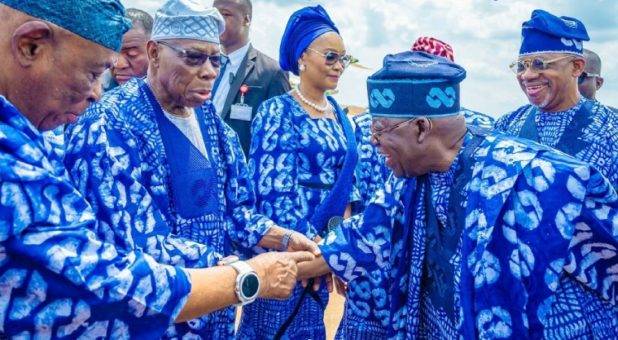

It was a sultry afternoon in Abeokuta and Olusegun Obasanjo was glowing in an adire outfit belonging to Bola Ahmed Tinubu. Imagine that? No, you saw it. The fabric owned his body, its simple grandness wrapping his octogenarian shape. He did not just don it, it adorned him. It invested him with a sort of imperious dignity.
Obasanjo was not alone. He wore it in the tradition of what Yorubas call aso ebi. And he stood in line waiting with other political dignitaries for whom? Of course, President Bola Tinubu. All the men planted themselves in sameness, the same attire. But the man was different. He did not belong to the milieu, in moral and political sense. Baba was not one for that kind of uniformity. To costume was not his custom. He was baba, but he was forced to play the humble old man.
It is not the sort of setting where he could bully or inspire obedience. He was more odd than old in the place. But he was there not because he was president but because, one, the governor wanted him there, and, two, the president had no objection. The president must have been told ahead that he was going to see baba in his “uniform.” What humour. He was also there because he is from Ogun State. His Ota, with all its controversy of Bells University, coerced donations and library, also reside in that state. To all intents and purposes, he is a baba of the state. Lastly, politics can once in a while abide a comedy from an old man.
The roll call was mighty. Governor Dapo Abiodun was host, and governors from across the country materialised, including former governor of the state, Aremo Segun Osoba. That must be the political attire of the year. Not because of the design or colour or texture. There was nothing new about broken shackles. But it was so because of the man who wore it.
When President Tinubu arrived, he shook hands with the old man and even greeted him, “Baba.” Not done with the kinship of the clothing, OBJ drew attention to the shoes both of them wore, as though what they call “anko” – meaning dressing alike – also spilled down to their footwears.
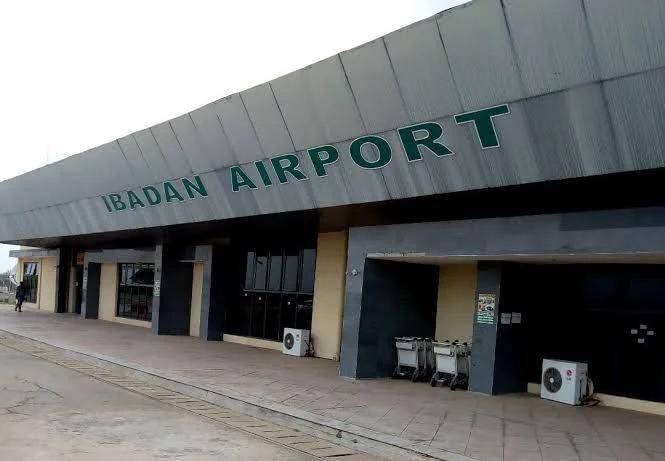
It was a sartorial surprise, not just because we saw it in public, but because no one saw it coming. No one could imagine it. The event was innocuous enough. The president was in Ogun State to open its cargo airport. But the event carried a cargo of its own. Obj had made a statement. Not by his words but by his image. Not his own image, but the image of the man he did not like. The man he had campaigned against for most of the past two decades. The man who had defeated him fight after fight. The man he duelled in vain in 2023. The man he rallied the youths to rebel against and “Occupy Nigeria.” The man he plotted in vain to overthrow as governor of Lagos State by way of impeachment, the same way he exercised gangster schemes to exorcise Alamieyeseigha, Dariye and his “favorite” son Fayose from their legitimate offices.
The same man for whom he was now performing a fashion show. I want to know how he agreed to such a public display. Whose idea was it, he or the governor? How dare anyone ask the great OBJ to put on an adire bearing his arch-enemy, his terminator, that is that stubborn boy Bola, as he had once characterised him. To dress him in borrowed robes? The same person called the last man standing at the expense of his wobbly feet. Who was the tailor, and when and where was it sown and designed? So, he agreed to subsume his own person under the cover of the man who gave him nightmares? And the image will cover his naked body, and even spy it?
It would seem an act of friendship on the surface, or a cultural routine in Yorubaland. But not with a man called Obasanjo. As Mobolaji Sanusi showed in his column in this newspaper on Saturday, Obasanjo did not do that because he woke up to be a Tinubu fan. But it is the gallows’ humour of it all, its funereal hint in a power game that it inspires. The humour was not lost on the president himself. He knows Obj well. He does not need anyone, as Sanusi has endeavoured in his column, to warn him of the stratagems of the Owu chief. He is a familiar customer.
Tinubu may be flattered by the show of sartorial love, but he knows it is no love. It is a feint. Obasanjo is a soldier. If he knows anything, it is ambush. We know he was a victim of some sort of ambush during the civil war when a gutsy Biafran soldier shot him in the bottom as he fled into his vehicle. This was the testimony of Colonel Oyinlade Iluyomade, who was an eyewitness.
The paradox of that sartorial moment was that it is now well-known that the man knows how to deceive. He is a nostalgist of his own ambushes. He is also a political aesthete of subversion. We recall that his old tactic as president was the pounded yam, or what Yorubas call iyan. He loves pounded yam and egusi and bush meat, according to his first wife who was interviewed for the African Concord by Ohi Alegbe and Dele Momodu. She added, for emphasis, that it is because “he is a bushman.”
He visited then senate president Chuba Okadigbo, and he ate pounded yam. After the gastronomic drama, the next step? He organised his impeachment. The colourful Chuba exited in what was an anticlimax of a career in politics that spanned decades. As party chairman, Audu Ogbe’s wife made a hurried pounded yam, and after one or two belches, he thrusted a letter of resignation. Obj had no respect for domestic civility or dignity. His wife was present. It was a day of joy, and it was like the Owu chief to craft a sour ending, even if the iyan was sumptuous. From pounded yam to resignation.
So, Obj knows he cannot ask Asiwaju to make iyan for him in Aso Rock, and so he wants to stoop in adire. Whether or not he wanted it, by wearing that attire, he had propagated the president’s broken shackles image. He did not need words, he used spectacle.
We are less in the age of words than in the age of images. As Andre Agassi once said, “image is everything.” The media philosopher, Daniel J. Boorstin, spoke of our age as the graphic revolution. In the age, he distinguished between image thinking and ideal thinking. What the Owu chief was trying to explore is image thinking. But the world has made a link between image thinking and ideal thinking. With images, we clarify ideas in our minds.
The image of the Owu chief in Tinubu’s image is a surrender without knowing it. It is image-speak. That very episode of the handshake and allusion to their footwears is what the French writer and thinker refers to as “the spectacular,” in his classic book, Society of the Spectacle. He demonstrates, as a Marxist, how image can be exploited to mow down the weak among us, and how the weak embrace the tropes of their oppressors. Obj may be harbouring a revenge. He probably will not forgive Tinubu for humiliating him in his costume.
Sanusi needs not worry about the Owu man’s decoys and ambushes. The president knows, as Jesus warned, not to judge according to appearance. But what is significant in his move is how it shows that the opposition has run out of ideas. They are not original in their thinking. While an Obj would want to wear the clothes of his enemy, the ADC is playing undertaker by seizing the party that is already established. Now, we hear they want to dump the ADC and hop to PRP. Not the sort of crowd Aminu Kano would have welcomed to his party. This is an identity crisis. David Mark and co are seeking the names and cover of others. Obj is seeking the garment of the president.
If Obj is wearing the attire of the president, the other opposition men are donning the identity of other parties. What is missing though about the fashion show is a lack of quotable quote from the Owu chief. Why did he wear it? Was he going to keep it? Or is he bidding his time for a moment, perhaps, during the campaign when he will conjure a grievance? Will he make a public display of tearing the attire or making a bonfire of it? Just as he did with the PDP membership card? No reporter of enterprise seized that opportunity.
We know that the time will come when he will show his distaste in Ota. He should always remember that he embraced the same Tinubu in 2022, and seemed to have endorsed his candidacy. This essayist extolled the drama of father and son. But, as the Yoruba say, the bird was in his pocket for some kind of late stunt. That stunt was an anticlimax in Peter Obi. He was stunned in the end with a defeat.
If anyone loves theatre in Nigerian politics, it is the man who wore another man’s attire.